
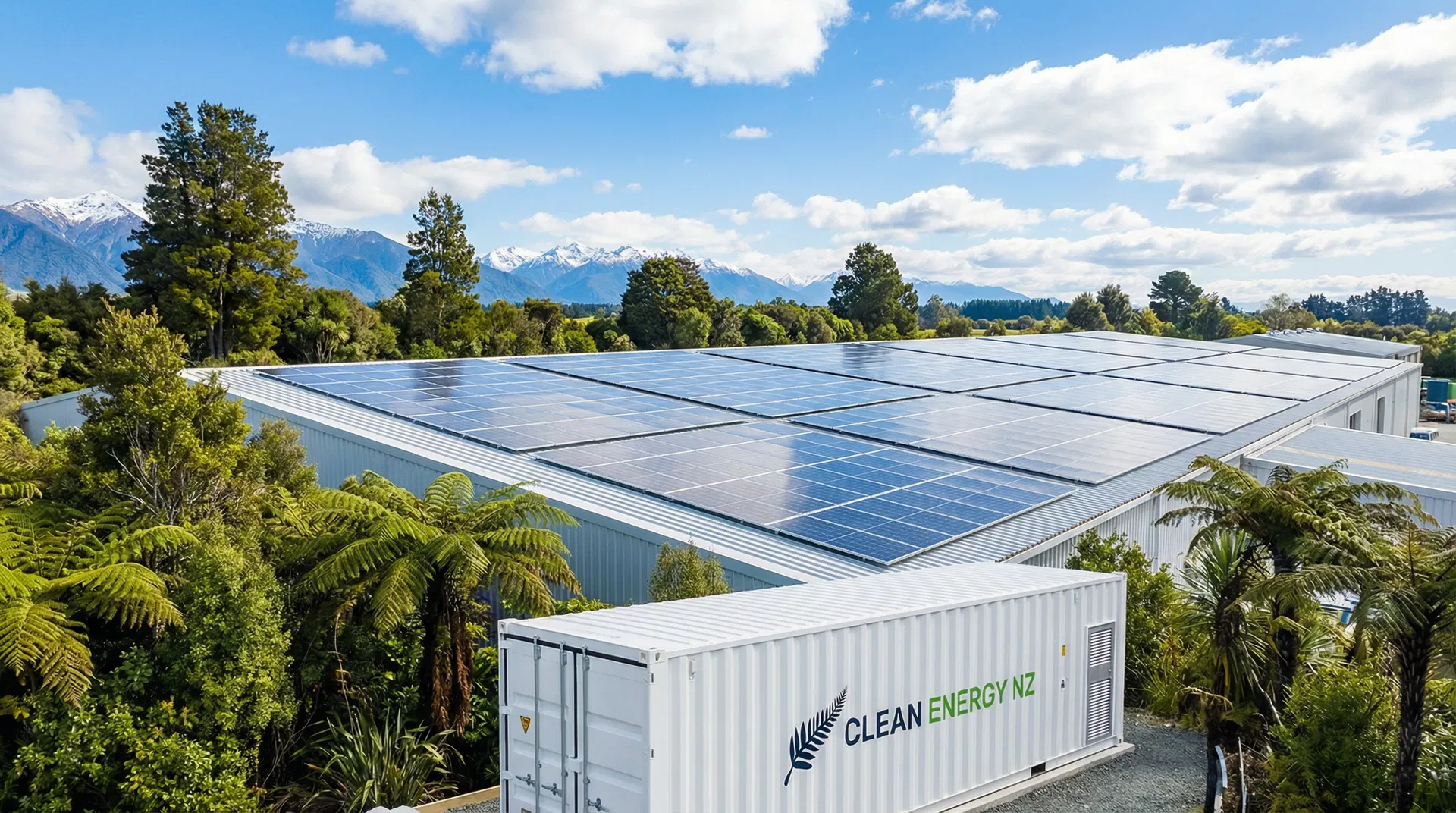
NZ's Climate Commitments and Business
New Zealand has committed to reducing net greenhouse gas emissions to 50% below 2005 levels by 2030 and achieving net zero by 2050. While the country's electricity grid is already approximately 82% renewable—one of the highest rates in the world—the remaining 18% comes primarily from gas and coal-fired generation that operates during peak demand periods. This is precisely where battery storage makes its greatest environmental impact.
How Storage Enables Renewable Energy
Renewable energy sources like wind and solar are inherently variable. Wind generation peaks overnight and during storms; solar generation peaks at midday. Neither aligns perfectly with commercial demand patterns, which typically peak in the morning and late afternoon. Battery storage bridges this gap by storing renewable energy when it's abundant and releasing it when it's needed. At a grid level, widespread adoption of commercial battery storage reduces the need for fossil-fuel 'peaker' plants that fire up during high-demand periods.
Reducing Your Carbon Footprint with BESS
Every kilowatt-hour of energy shifted from peak to off-peak periods reduces the grid's reliance on thermal generation. In New Zealand, peak electricity has a carbon intensity of approximately 0.15–0.25 kg CO₂ per kWh, compared to 0.05–0.08 kg CO₂ per kWh during off-peak periods when hydro and wind dominate. A commercial battery system cycling 200kWh daily can reduce a business's carbon footprint by 8–12 tonnes of CO₂ per year—equivalent to taking 3–4 cars off the road.
Corporate Sustainability Reporting
For businesses subject to mandatory climate-related disclosures under the Financial Sector (Climate-related Disclosures and Other Matters) Amendment Act, battery storage provides a tangible, measurable emissions reduction that can be reported with confidence. The investment also demonstrates proactive climate action to stakeholders, customers, and investors. Many New Zealand businesses are finding that their sustainability commitments are becoming a competitive differentiator, particularly when tendering for government contracts or partnering with environmentally conscious supply chains.
The Circular Economy of Batteries
Modern Lithium Iron Phosphate (LFP) batteries, such as those manufactured by Pylontech, are designed with end-of-life considerations in mind. LFP chemistry contains no cobalt, nickel, or manganese—materials associated with environmental and ethical concerns in other battery chemistries. At end of life (typically after 15+ years), LFP batteries retain 70–80% of their original capacity and can be repurposed for less demanding applications such as residential storage. When batteries are eventually recycled, over 95% of materials can be recovered and reused. Pylontech operates its own recycling programme, ensuring a closed-loop lifecycle for its products.