
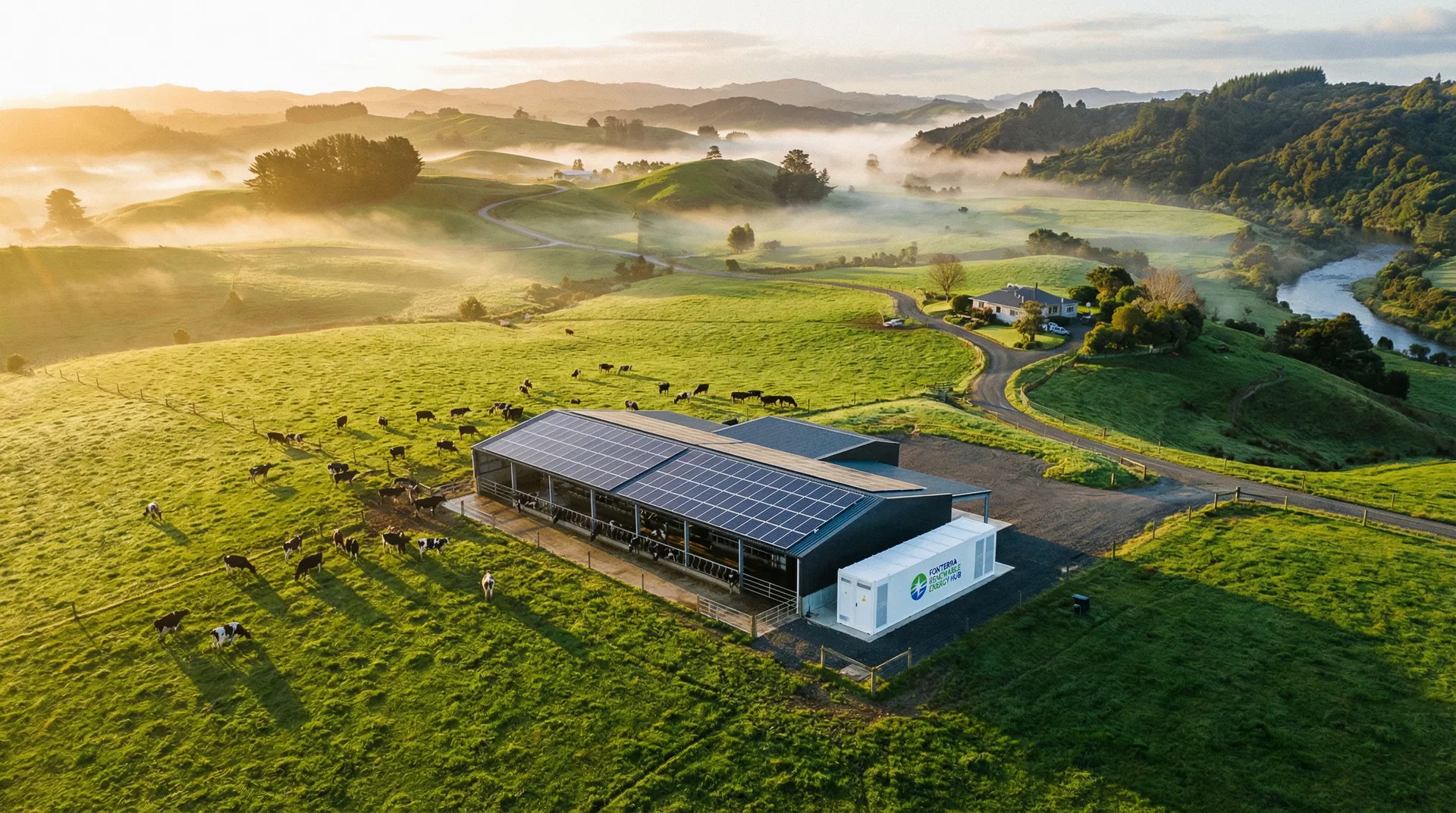
The Rural Energy Challenge
Rural New Zealand faces a distinct set of energy challenges that urban businesses rarely encounter. Long distribution lines mean higher line charges and greater exposure to outages. Many agricultural operations are located at the end of the grid, where power quality issues—voltage fluctuations, frequency variations—can damage sensitive equipment. For dairy farmers running milking parlours, wine producers managing temperature-controlled fermentation, or packhouses operating sorting and grading equipment, reliable power isn't just convenient; it's essential to product quality and animal welfare.
Dairy and Livestock Operations
New Zealand's dairy industry is the backbone of the rural economy, and modern dairy operations are increasingly energy-intensive. A typical 500-cow dairy shed consumes 40,000–60,000 kWh per year, with peak demand during the twice-daily milking cycle. Refrigeration for milk cooling represents the single largest energy cost, and any interruption to the cold chain can result in significant product loss. Battery storage provides both peak demand management and backup power, ensuring milking operations continue uninterrupted during grid outages.
Viticulture and Horticulture
New Zealand's wine industry, valued at over $2 billion in exports, depends on precise temperature control during fermentation and storage. A power outage during vintage can compromise an entire season's production. Similarly, kiwifruit and apple packhouses require consistent power for controlled atmosphere storage. Battery systems sized for these operations—typically in the Tāne 100 to Tāne 200 range—provide the critical backup power needed to protect high-value agricultural products.
Solar Plus Storage: The Rural Solution
The combination of solar PV and battery storage is particularly compelling for rural operations. Agricultural properties typically have abundant roof space on sheds, packhouses, and other structures, making solar installation straightforward and cost-effective. A well-designed solar-plus-storage system can reduce grid dependence by 60–80%, dramatically lowering electricity costs while providing backup power. For operations in areas with frequent outages, this combination effectively provides energy independence.
Case for Energy Independence
The economics of energy independence are increasingly favourable for rural New Zealand. With grid electricity costs for rural consumers often 20–30% higher than urban rates (due to longer distribution lines and lower network density), the savings from solar-plus-storage are proportionally greater. A typical dairy farm investing $120,000–$180,000 in a solar-plus-storage system can expect annual savings of $15,000–$25,000, with payback periods of 6–8 years. Beyond the financial return, energy independence provides peace of mind and operational resilience that is difficult to quantify but deeply valued by rural business owners.