
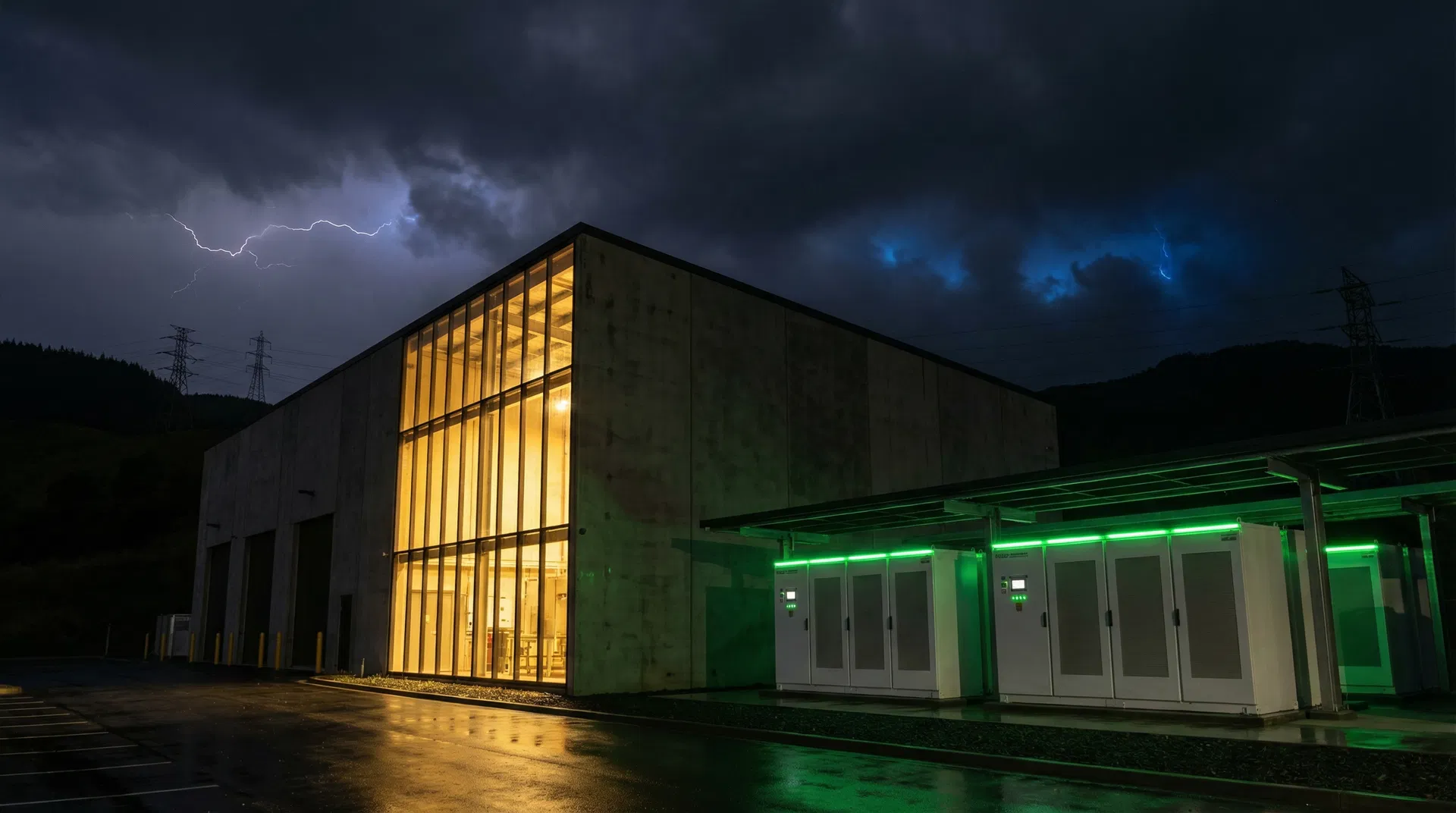
The True Cost of Downtime in New Zealand
When the lights go out, the clock starts ticking. For a cold storage facility, every minute without power means rising temperatures and product at risk. For a manufacturing line, an unplanned shutdown can mean hours of recalibration, wasted materials, and missed delivery deadlines. For a data centre, even a few seconds of interruption can corrupt transactions and breach service-level agreements. Across New Zealand's commercial and industrial landscape, unplanned power outages are not merely inconvenient—they are devastatingly expensive. Industry estimates put the average cost of downtime for a mid-sized NZ business at $5,000 to $15,000 per hour, with some sectors facing losses exceeding $50,000 per hour. Yet most businesses still treat power reliability as someone else's problem.
Why the Grid Can't Guarantee Uptime
New Zealand's electricity grid is one of the cleanest in the world, but clean does not mean invulnerable. The grid was designed for a different era—one with fewer extreme weather events, less distributed generation, and lower peak demand. Today, the reality is different. Cyclone Gabrielle in 2023 left tens of thousands of businesses without power for days. The Auckland Anniversary floods caused widespread outages across the country's commercial capital. Even outside major events, ageing distribution infrastructure in many regions produces dozens of unplanned outages per year. Rural and semi-rural businesses are particularly exposed, with some areas on the Transpower network experiencing average outage durations of 4–8 hours per event. Lines companies invest heavily in maintenance, but the physics of long distribution lines through challenging terrain means that some level of outage risk is simply unavoidable.
How Battery Storage Eliminates Outage Risk
Traditional backup power—diesel generators—has been the default solution for decades. But generators come with significant drawbacks: they require regular maintenance, produce emissions, take 10–30 seconds to start (an eternity for sensitive equipment), and their fuel supply is finite. Battery Energy Storage Systems (BESS) represent a fundamentally different approach. Rather than reacting to an outage after it happens, a battery system operates continuously alongside your grid connection, monitoring power quality in real time. When the grid fails—or even fluctuates—the battery responds in milliseconds, not seconds. There is no perceptible interruption. Your lights stay on, your compressors keep running, your servers never skip a beat. This is not backup power; this is uninterruptible power.
Millisecond Response: The Technology Behind Seamless Switchover
The secret to seamless switchover lies in the inverter technology and battery management system (BMS) at the heart of modern BESS installations. Pylontech's commercial systems use advanced bi-directional inverters that continuously synchronise with the grid frequency. When grid power drops or distorts beyond acceptable parameters, the system detects the anomaly within 5–10 milliseconds and transitions to island mode—powering your facility entirely from stored energy. The transition is so fast that even the most sensitive electronic equipment registers no interruption. The BMS monitors every cell in the battery array, balancing charge levels, managing thermal conditions, and ensuring the system can deliver its full rated power at a moment's notice. When grid power returns, the system seamlessly reconnects and begins recharging, ready for the next event. For businesses that currently rely on Uninterruptible Power Supply (UPS) units for critical equipment, a properly sized BESS can replace both the UPS and the backup generator in a single integrated system.
Building Your Energy Fortress: A Practical Roadmap
Building an energy fortress doesn't happen overnight, but the path is straightforward. The first step is a comprehensive energy audit that maps your critical loads—the equipment and systems that absolutely cannot lose power—and your non-critical loads that can be temporarily shed during an extended outage. This analysis determines the minimum power capacity (in kW) and energy capacity (in kWh) your battery system needs. For most commercial operations, a system sized to support critical loads for 2–4 hours provides robust protection against the vast majority of outage events. A typical mid-sized commercial installation—say a 100kW/200kWh Pylontech Tāne system—costs between $180,000 and $280,000 installed. But here's the key insight: unlike a diesel generator that sits idle 99.9% of the time, your battery system works for you every single day. During normal operations, it performs peak demand shaving, reducing your electricity bills by 25–40%. It shifts energy consumption from expensive peak periods to cheaper off-peak hours. It smooths power quality issues that can damage sensitive equipment. The backup power capability is, in effect, a free bonus on top of a system that pays for itself through daily energy savings. When you factor in avoided downtime costs—even a single prevented outage event can save $20,000–$100,000—the return on investment becomes compelling. Voltaic's energy configurator can model your specific scenario and provide a detailed cost-benefit analysis in minutes.